Monday, January 18, 2016

Classic Meets Modern

Almost 2 years ago I acquired what I believe is a 1979 Peugeot PV10 .  Searching through various online catalogs I found this Picture of a PV10.  It is from a 1979 French catolog and was the closest match to the components that were on the bike. Using Peugeot's serial numbers to date a bike is said to be a bit dubious but, going by the serial number, decals and components It would appear to be circa 1979


 The bike as I came by it had everything in the picture accept the seat post, saddle and pump. As far as I'm concerned it was lucky that I stumbled upon this bike in my size while I was visiting my local bike shop. Most of the bikes on craigslist these days are low end or overpriced.


  Here's a picture of the bike after I began to rebuild it. I should of taken photos of it before I did anything but I get so excited when I get a new project that I forget to document the original bike before I start to clean it up and rebuild.


Stronglight 105 Bis Crankset with 52 x 42 chainrings. Love the drillium!


Mafac non aero brake levers with more drillium


New rear wheel on the left next to the original on the right


The original wheels were Mavic 700c tubulars with Normandy hubs and a Malliard 5 speed freewheel.  I thought a long time about the way in which I would rebuild this lovely old bike. I toyed with the idea of riding tubulars, and tried to figure out a way to keep the cool Stronglight cranks. Ultimately I knew the 42 - 52 chainrings were just too large for me to ride up hill. Even if I used a 12-36 cassette my lowest gear would be about 31 gear inches which for me just isn't low enough when climbing longish steep grades. So I had a new set of wheels built with Mavic Open Sport rims, Ultegra hubs, Ultegra 10 speed 12-30 cassette, Wheelsmith butted spokes and alloy nipples. Practical wheels which suited the bike but allowed me to use clinchers. The tires I selected were 28 mm Grand Bois, Cerf, Extra Leger. 


I replaced the Stronglight cranks with Velo Orange's Grand Cru 50.4 BCD 46 x 30 cranks.  I think the they look appropriate for a bike of this era. The 46-30 chainrings combined with the 12-30 cassette gives me a gear inch range of 26.7 - 102.2 

Because of the french threading it was fortunate that I was able to use the existing loose ball bottom bracket and spindle with the new crankset.  Since I spread the rear dropouts 4 mm to accommodate a modern cassette hub it would have been ideal if I had a slightly longer spindle to compensate for the change in the chainline. That was not to be the case so the shifting is slightly compromised.  Meaning the chain will rub on the next chainring when shifted to the furthest sprocket. Of course one is always advised to avoid that sort of shifting anyway. 


The only original parts that were used were; the bottom bracket, headset, and brakes. The original pedals were Atom with french threading so they can only be used with the original crankset. The Peugeot stem was too short for me and the Phillipe handlebars just weren't as comfortable as the Nitto 115 that I replaced them with.  I kept the Weinmann 605 sidepull brakes because I didn't want to alter the frame in any permanent way by drilling out the brake mounting holes. Modern brakes have recessed bolts not the nutted bolts common on most older single pivot brakes. Also the reach is longer than most modern dual pivot brakes. I would have used the original front derailleur but it was a cheap plastic Simplex common on Peugeots in the 70's and broke in my hands when I picked it up! 


Down tube shifters just aren't my thing and I had a perfectly good set of ShimanoTiagra 4600's lying around so that was kind of a no brainer. The front and rear mechs were used Shimano 105 and Ultegra respectively that I picked up at the bike shop.  The 26.6 seatpost was an oddball size that limited my choices so long setback wasn't going to be an option. Without a long setback seatpost a Brooks saddle was out of the question for me. I made a lucky guess and ordered a Selle SMP TRK which I found to be comfortable.  


Even with the modern drivetrain I feel the essence of the bike was maintained. Velox bar ends and a tool roll attached to the saddle with a Christophe toe strap give a slight nod to the era.


Friday, May 2, 2014

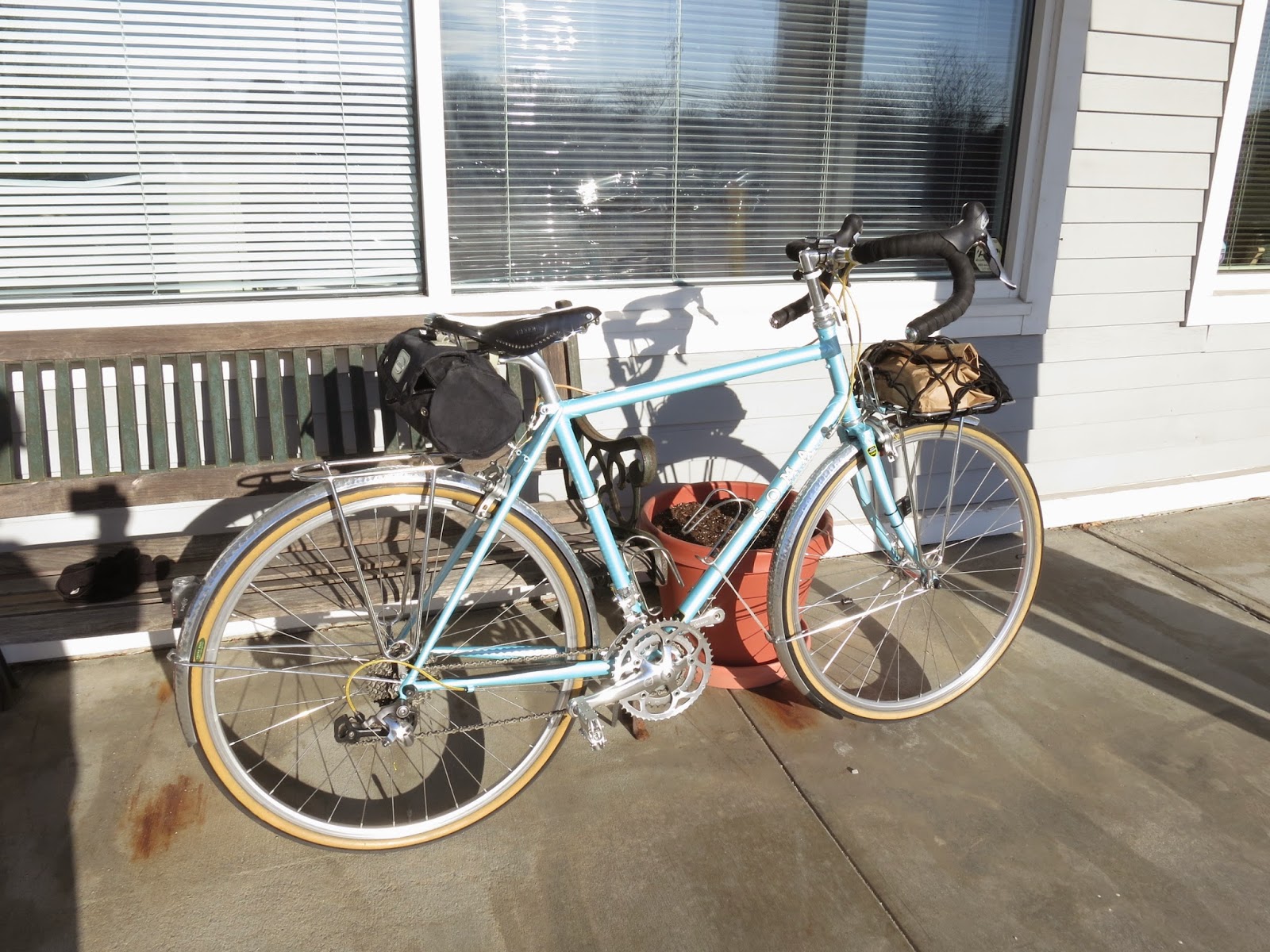
Soma San Marcos, an in depth review

This is my 51 CM Soma San Marcos purchased and built in Late September 2012. Built as an alrounder with a retro / randonneur vibe. For those who may not be familiar, the San Marcos was designed by Grant Peterson of Rivendell Bicycles for Soma Fabrications.
ALERT - this post is filled w/technical data that some may find boring. If you just want to know about the overall feel of the bike, just look at the pics and skip down to the final few paragraphs.


The Obligatory garage door photo


Even before my Cannondale was stolen from my garage I had already been searching for a new bike. I was looking into a semi custom Gunnar and playing with the geometry on bike CAD when I discovered the Soma San Marcos. I plugged the specs into Bike CAD and realized the San Marcos would give me the fit I was looking for at a much lower price, $800 vs $1650. Some may argue that there is a difference in quality between the two frames. The San Marcos is Tange Prestige with a Tange Infinity fork, while the Gunnar's are made from True Temper. I believe the main tube thickness for the San Marcos is a respectable 9/6/9. The feel of the Tange is compliant without being noodlish. I decided to pull the trigger and started collecting parts for the build.


Steve at Niantic Bay Bicycle built the 650b wheels at my request with Synergy machined side wall rims, Ultegra hubs, Wheelsmith double butted spokes and alloy nipples. At the time Velocity's 650b Synergy rims were the lightest ones available but the machined side walls were on back order for quite awhile. Eventually they came off back order and the build began.
The astute may notice dry cracks on the sidewalls.
I originally purchased a set of Dia Comp 610 center pull brakes, but the brake arms did not reach far enough on the rear. I lucked out because the shop had a rear Paul Racer hanging around. It had been too short on another build, so I got it at cost!  As you can see in the photo, the Paul Racers are just barely long enough.

Classic Rivendell Lugs
About 9 months after the initial build I up graded the front brake to a Paul Racer. I immediately felt a significant difference in the braking power.

Cane Creek 100 Classic threaded headset and a Funky Monkey
Even before I up graded the front brake, I changed the cable hanger to a Paul Components Funky Monkey. It kinda of sounds like a Ben and Jerry name doesn't it? Weird name, nice product.  

The Funky Monkey's barrel adjuster is by far the easiest to adjust of all the cable hanger barrel adjusters I have tried. The added length of the Funky Monkey reduces the amount of cable running from the barrel adjuster to the brake reducing the potential for cable shutter on a larger bike. 
Being able to adjust the Funky Monkey's barrel adjuster easily is vital since I've found it necessary to loosen it in order to open the brakes via the quick release when I want to remove the wheel.

Shimano 105 STI Brifters
Initially I had set up the bike with Shimano Tiagra brifters, since I had used them on the Cannondale and found them to be adequate. The new, at the time 4600 Tiagra line had just become 10 speed and had benefited from the higher end components trickle down affect.  The Tiagra's price point was a little easier to handle at the time of the initial build so that is what I put on the bike. The 4600 Tiagras had a different shape from the 4500 Tiagra I had on the Cannondale but I got used to it and found they shifted well with the 105 rear derailleur and IRD Alpina front derailleur. I later changed to the 105 brifters pictured above.

To me the 105 brifters have a nicer shape which is both more comfy and visually more appealing. The 105's also pull more brake cable thus increasing modulation. The cables exit at the handle bar making it easier to mount a small bag. One note about the 105 shifters, when shifting from the small 24 tooth chainring to the 36 tooth ring I have to give the shifter 1.5 shifts to get it to shift up to the 36 tooth ring. Interestingly with the Tiagra shifter the front derailleur was able to shift to the middle ring with only 1 shift. It was a little slow but it got there in one swing of the brifter's arm. Perhaps the extra turn the cable makes inside the brifter to allow it to exit at the handle bar creates just enough cable friction to cause this sub-optimal shifting with non Shimano parts. 

Note the flare of the 105 shifters

I had purchased a Nitto Randonneur handle bar for another bike, so when I was changing the shifters I decided to try them. Originally I had used the Nitto B115 drop bar, but I wanted a little more length in the ramps. I really love the shape of the Randonneur bar, the flare is very comfy and creates a sort of hip at the first bend. The increased length of the ramps allows me to move my hands more and gives my whole body a choice to be more upright or more aero.

Funny how one change leads to another.  After I changed the handle bar to give me what was essentially about 10 cms more reach I found I wanted my Brooks saddle setback more.  Sadly I removed the beautiful Thompsons zero setback seat post and replaced it with an old Sun Tour seat post w/setback which I found to be much more comfy. Eventually I changed to a Velo Orange Long Setback seat post which allows micro adjustments to the seat angle.


Velo Orange long setback seat post with Brooks saddle set all the way back.


Lovely Nitto Randonneur handle bar and a Nitto stem

The final change to the original build was the fancy gold Jagwire housing. I had to change the cables since I was changing shifters so I decided to go ahead and change the housing too.


Paul Components Light mount with Light & Motion Urban 550 light attached.


Here is the final Paul's product I have on the San Marco. It's their light mount which I have stuck a handle bar plug into and mounted it to half of an old brake arm, which I then mounted to the front rack. I used the brake arm to allow the light to be mounted a bit lower which makes it much easier to remove when needed. Otherwise it would be dead level with the rack, which sometimes causes interference with items on the rack. I like having the light mounted at tire height beneath the front rack.  You can see the road well without shining your light into the eyes of oncoming traffic and the cargo on the rack never interferes with the light's beam.

My front rack hack 


I only have one beef with Soma. Why didn't they have midfork braze-ons in the first place?  The new 2014 models all have midfork braze-ons, but the original models didn't.  So you have two options, use p-clamps to mount a front rack or get a different rack that allows you to mount to the dropout eyelets. The later is what I chose to do, although I think such an arrangement may increase the fork's stiffness.

  Originally I had a small cut down Wald basket mounted to the rack. This was quite convenient but baskets can also cause limitations in regard to the size of the load you can carry.  IE. I couldn't carry a 12 pack flat on its side. Thus my rack hack was born. It is the top part of the Wald basket bent to approximately a 10 x 10" square which I clamped onto the Velo Orange front Constructeur rack. 

Front rack in use, semi wet rain gear on the bottom with stuff from store on top all strapped down with a basket net.
The VO. Construteur front rack is quite strong and light at 425 grams. 

note the way the rack attaches to the fender in two places

I also installed a VO. Construteur rack on the rear of the bike. At 365 grams it is one of the lightest rear racks available. It is a bit small at 4.3 x 10.23 inches, the hooks of my inexpensive panniers just fit on the rails.  The rack is mounted to the fender and the rear dropout eyelets which is surprisingly sturdy.
 

Velo Orange Cranks and touring pedals
The crankset is a Velo Orange triple with 24, 36, and 48 tooth chainrings. I love my triple, combined with an Ultegra 12-30 cassette it gives me 21-105 gear inches. Now that's range!  I'm also quite fond of the VO. Touring pedals. They are super light at 236 grams for the pair while being plenty comfy and grippy. 

As I mentioned earlier I am using an IRD Alpina front derailleur. I chose the Alpina because it is supposed to provide better shifting with the smaller 48 tooth outer chainring. Perhaps if I ran a Shimano 105 front derailleur the shift from the small to the middle ring would be cleaner?  I wish Shimano would be like Sram in regards to having the same amount of cable pull for the road and mountain shifters.  This would allow both groups to be interchangeable and make it easier for someone like me who prefers to run smaller chainrings with STI shifters. 

All that being said, I don't spend a lot of time in the smallest chainring.  Most of the time I only have to shift from the 24 to the 36 tooth ring when I start out in the morning, since I park the bike for the night with it in the smallest chainring and sprocket.


The final bit of Velo Orange bling are the hammered fenders. Initially I had the VO. Zepplin 52 mm fenders for 650b wheels mounted but they were really wider than needed for 32 mm tires. Also it was my first time mounting a pair of aluminum fenders, hence errors were made. Here's a tip for anyone who has never installed metal fenders; squeezing the width of the fender to make it narrower effects the radius, essentially making it larger. I Eventually got the Zepplins installed but decided to change to the 45 mm hammered fenders later on.

I like the look of both fenders but the hammered fenders hide small scratches. I attached a Spanniga Pixeo Xba tail light to the rear fender, which required 2 holes to be drilled.


My first set of tires were Hutchinson 650b x 32 mm. I managed to get about 2300-2700 miles out of them before I had to replace the rear tire which was just about ready to go. Currently I am using the Grand Bois 650b x 32 mm Cypress tires. As you can see in the photo above, the sidewalls are getting cracked and dry. I also have a couple of small gashes in the tread of the rear tire, but I still have quite a bit of tread left. They have been run for approximately 2000 miles. 

 Soma San Marcos with the original build June 2013
So that's pretty much the build and some of my thoughts about it but what do I think about the finished product and the frame itself?  After riding 4500 miles I can say I am completely in love with this bike 95% of the time. The other 5% of the time I wished the bike were a bit lighter.

It's not really a heavy frame at about 6 lbs for the frame and fork, and I tried to select the lightest parts I could while still having all the features I wanted. Before I put the racks, kick stand and bag with gear on the bike it weighed 26 lbs.  Once I added the racks, etc. the bike gained 5 lbs. To loosely quote Grant Peterson,"it's hard to build a useful bike for less than 30 lbs".  The five percent of the time when I wish it were lighter I'm usually carrying some weight and/or going up hill or against the wind.

Lets get back to the 95% of the time when I am completely smitten with this bike. First thing is the fit, it's everything I hoped it would be. When I first started riding this bike It was like it was made for me. The Cannondale fit me pretty well once I had the stem extender installed, so that was my starting point when I started plugging dimensions into bike CAD. The San Marcos is 2 cm longer in the top tube, which I was a bit worried about, so I used a shorter 50 cm stem. Once I started riding the bike I was happy to have a little extra room to stretch out. 

 I am using a Nitto Technomic stem with about 4 inches of rise. Let me first say I love the threaded stem with it's ease of height adjustment. Also I personally prefer the aesthetic of a threaded stem. I must also compliment the geometry/design that Grant Peterson used on this bike. With a longish head tube set at  71 degrees, the higher you raise the stem the more it moves back towards you, effectively shortening the reach.

I also love the slacker seat tube angle of 71.5 degrees. That is an angle that is extremely hard to come by in a 51 cm frame, the typical angle is 74-75 degrees. My knees appreciate the slacker angle and I doubt that I would be able to use a leather saddle with their usually shorter seat rails if the seat tube angle was any steeper. 
 
 
Another uniquely Grant Peterson design is the lower bottom bracket height. With my seat set at maximum height for me I am still able to comfortably put my toe down while remaining seated at a stop light. The bike suffers no  clearance issues due to the lower bb. On the contrary I have ridden it through wooded trails filled with rocks and roots with nary a problem. 

The ride is sublime. It rides like a Cadillac, smooooooth.  I'm sure it must be the combination of the Tange Prestige steel and the supple 650b tires. On the road the ideal tire pressure for me is 60-55 psi in the rear and 40-35 psi in the front. Being a 51 cm bike I'm sure it is stouter than it needs be since a small diamond frame is inherently strong. On the other hand I have no worries that the tubes will dent easily and I have full confidence it can handle any load I pile onto it.

Aesthetically I never grow tired of looking at this bike. The color is a pearlescent turquoise which photographs more like a light blue. It is a difficult color to capture.  

Unless I one day have a custom frame built for myself, I am sure I will be riding the San Marcos for a long time.

Thursday, March 20, 2014

Errandonnee 2014

March 3, 2014

My winter bike parked outside of work.
Back at work after running some errands.

Home at last
 

    Destination
  • Work, bike shop, lunch
  • I rode my bike to work. During my lunch hour I went out to pick up some tire sealant at my LBS and some lunch at Subway. I finally arrived home 13 hours later.
  • Observations -  The Serfas 500 light does a great job lighting my way in the dark.
  • Total Miles - 30

March 10, 2014

Poised to go to the store and return some bottles


High security at the Big Y
Just the essentials, beer, coffee and milk
   
  Destination
  • Grocery store; Big Y and A&P package store.
  • I learned how much I can fit in my front basket with a six pack.
  • Miles - 5


March 12, 2014


Destination
  • Personal Care - Chiropractor
  • Wild Card - Staples
  • Observed - Geese eating something green in the ice.
  •  Miles - 16


   March 16, 2014

Bike parking at Stop & Shop


All loaded, 60 lbs or so
    Destination
  • Grocery store - Stop & Shop in Old Saybrook, CT
  • Observation - My bike is sweet!
  • Miles - 10       


March 18, 2014
        
My Soma San Marcos parked at work after running a few errands during lunch
Stopped at the library on the way home from work


 Back home at 6:30 PM

    Destination
  • Work and library
  • Observations - The library has lots of DVD's but they're difficult to select without using the computer catalog.
  • Miles - 23


March 19, 2014


Stopped at Pedal Power for their grand opening

Destination

  • Bike shop and personal care, (chiropractor) again
  • Observations - Head winds really stink.
  • Miles - 16
                             Total Miles - 100

Friday, March 7, 2014

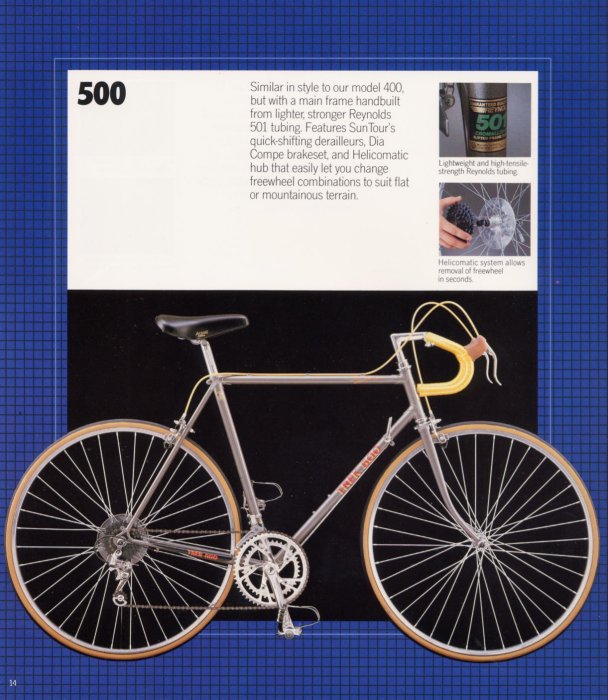
1984 Trek 500 Series


I picked up a 1984 Trek 500 at bike show/swap in Dudley. At that time the bike was built as a fixie which didn't interest me at all. So I purchased the bike without its wheels and chain. It had bull handlebars, an inverse brake lever and track pedals.
Mostly what I wanted was the frame. 

The bikes original configuration was a drop barred sport bike. It came in two colors, mariner blue and pewter as pictured below. Mine is blue. Now that the bike is in at least its third configuration very little from its original build remains. I think the headset is the only original component left.


I built up the Trek 500 to be my winter ride. It's worked out fairly well. The tires could use a little more width but you can only use as wide of a tire as the bike will allow.  The only studded tire I found that would fit was Schwalbe's 30 mm snow tire. It doesn't have as many studs as their 35 mm Marathon Winter tires, but sometimes I think that's a good thing since the 30 mm snow tires are slow enough. The sidewalls have a nice reflective coating.  When I don't have the studded tires mounted I use Soma's New Express 32 mm terracotta tires. 


In addition to studded tires, I'm using a Nexus 8 speed internal gear hub with a kick brake. This set up has worked very nicely allowing me to mostly just ride and not worry about cleaning off the bike after every sloppy ride. I have a center pull brake on the front but it's pretty useless when conditions are wet and icey. 

The cockpit consists of a 90 mm Nitto Technomic stem which is quite pretty to look at when you're riding. I only mention that because Grant Peterson has pointed out the importance of a good looking stem since its in your field of vision most of the time. Anyway the rest of the cockpit is Velo Orange's ever so difficult to pronounce handlebars VO Montmartre, which are 42 cm wide. If I had to do it again I would select their Left Bank handlebar which is 49 cm wide with a little bit of flare in the grip area. 

An inverse brake lever controls the front brake and a JTek bar-end shifter allows easy logical shifting of the Nexus hub.
Logical because you shift up to move to a higher gear and down to move to lower gear.

To keep the road crud off of me, I mounted a pair of SKS Longboards. I've found the bear claw pedals to be quite comfortable and grippy, plus I think they look cool. To finish the build I added a Brooks b68 in honey with matching honey bar tape, and a Wald 137 basket. 


A couple of notes: Before I mounted the basket I had a funky old rack that I hacked to make a light sort of porteur rack. I wasn't crazy about the look of it but I think it worked better than the basket in regards to the amount of weight and volume it held. Ultimately I would like to put a real porteur rack on, if I can find one that isn't too heavy or expensive, this is my dilemma. Of all the bikes I own, this one handles front loads the best. Probably due to its mid-trail geometry, somewhere in the mid forties.


Truth be told I'm not that wild about the Brooks handlebar tape. It is difficult to work with and it offers no cushion. The last bit of problem I've been having is a common one with Brooks saddles.  I need more set back even though I am using the VO long set back seat post, it's still not enough. I am constantly pushing back. Raising the saddle height has helped a little. 

There maybe some changes made regarding the saddle set back, front rack and maybe the handlebars as I continue to tweek the fit.

Wednesday, March 5, 2014

So Long Febuary, Hello March

Everyone I know feels the same way, we've all had it with winter. Here in Connecticut we thankfully dodged the bullet on Monday, while the Mid-Atlantic region got slammed with snow. On the roads the snow has receded from most of the shoulders, so riding a bike is much easier. Here in Southeast Connecticut most of the landscape remains covered with at least 6 inches of hard snow. 


Since March began, I'm trying to bike commute to work more frequently than I did the past two months. On both Sat. 3 -1 & Tues. 3 - 4 I left for work on my winter bike with the temps looming around 9 -10 degree's. Fortunately it wasn't windy on either of those days. Today we've made it into the 40', so 
hopefully that will be the new trend.

It's not just the cold and the frozen cruddy looking stuff along the roadsides, and the never ending shoveling, but it's also the grey dreary sky's day in and day out, that our getting really old.  


The stores all think it's spring, replacing winter clothing for short sleeve shirts, shorts, and bathing suits.  About a month ago toe warmers became hard to find. Baseball mitts and bats replaced them, so I ordered a lg. box from Amazon today. I can ride with just my shoes when its in the forties but below that I need neoprene booties and or toe warmers.
 

Here is a picture of the Old Lyme town beach parking lot on Feb 2nd. Under the snow is rutted ice, which I found virtually unridable.


13 days later the same parking lot after some rain and a couple of warm days.

This weekend we spring ahead, longer days yea, but it seems early this year.


Sunday, March 2, 2014

Sam Hillborne

Love the sage blue color and the build specs on this Rivendell,Sam Hillborne. Truly a great "country bike".


Monday, February 24, 2014

Amtrak and Bicycles


I've recently come across a lot of discussions about multimodal bicycle travel via train, Amtrak mostly. I of course have had my own problems trying to use Amtrak on a more recent bike tour, but that's a story for another time.

One of the discussions that first came across my radar was a post by  Off The Beaten Path, A Winter Adventure . Most of the discussion about bikes and trains took place in the comments section. The gist of it was how limited or in some cases completely nonexistant bike access is on Amtrak.

AmTrak Train
Image Source: http://cliffsrailpictures.smugmug.com

A post at bikeportland.org describes an encounter on Amtrak's Texas Eagle, experienced by writer Ely Blue and publisher / filmmaker Joel Beil. For a full account click on the link. A brief summary of the story goes like this: They were traveling overnight on a sleeper car with their Brompton folding bicycles brought on board as carryon baggage. In the middle of the night they were awakened and berated for doing just that. After a heated discussion it was agreed that the attendant would put the Bromptons in the baggage car.

                                                     Image Source - harriscyclery.net

For the record folding bikes are allowed as carryon baggage. It appears that it is not uncommon for Amtrak employees to be unaware of their policies regarding bikes. Blue states this inconsistancy as the reason they purchased the folding bikes. Most of Amtrak's trains don't allow bicycles accept for a limited number of trains on certain lines, which require the bike to be boxed and checked as baggage.

BikePortland.org posted a follow up;
Amtrak states that folding bicycles are always allowed onboard. They will be lauching a new program that hopefully willl allow all employees to keep up with the latest policies regarding bicycles. If this occurs the multimodal bike tourist won't be left at the mercy of each Amtrak employee they encounter.

Adventure Cyling Association is advocating for better service for bicyclist by joining Amtrak's new task force with other bike adovocacy groups. The focus is to expand bicycle service on Amtrak lines. For more info check out these links:
http://www.adventurecycling.org/resources/blog/positive-amtrak-news/

http://www.adventurecycling.org/resources/blog/new-developments-for-bicycle-services-on-amtrak/

In the state of Connecticut there aren't any Amtrak trains that allow bikes to be checked as baggage or even to be shipped via train. The Shoreline East commuter train does allow bikes to be rolled on! Here is a copy of their policy: Bicycles are permitted on board SLE trains operating between New Haven and New London (including all intermediate stations) only. All bicycles must be stored in a safe and secure manner to allow emergency egress by passengers. The cyclist should remain in close proximity to the bicycle, and must obey instructions of the train crew.

I read this as bikes must be somehow secured at the end of the cars where there is more space and the bicyclist must sit in a near by seat because they don't want to be responsible for your bike. The Part about obeying train crew instructions  seems ambiguous to me and possible code for being denied access.

Since this post is getting long I'll sign off for now. Stay tuned for more to follow.